Stick Pack Supplements: When Single-Serve Packaging Makes Sense

Most powder products start in a tub. It’s familiar, it’s practical, and it gives the customer multiple servings in one place. Offering a product in a format everyone already understands seems like the easy choice for brands.
However, a tub also makes a few assumptions.
It assumes the customer is home. That they have a scoop, counter space, and enough time to measure something out before moving on with their day. For some products, that is exactly right. For others, it misses the point.
Hydration does not only happen at home. Neither does energy, recovery, or daily wellness support. They happen in cars, gyms, offices, airport terminals, hotel rooms, and the few minutes someone has between everything else they are trying to get done.
That is where stick pack supplements earn their place. In changing how the product fits into someone’s day. The question to ask is, “What does this product need to do once it leaves the shelf?”
Format Is Part of the Product
Packaging is often treated like the final decision. After the formula, flavor, and other details are set, but that sequence can create problems.
Format affects the serving size, how the product travels, how it is dosed, how it is sampled, how it is merchandised, and how likely someone is to use it consistently. It also affects the production reality.
A powder may taste great in a sample cup but not make sense in a stick pack. The serving may be too large. The powder may not flow well enough. The format may drive the cost higher than the product can support.
Those are not packaging details. Those are product details.
A product can have a strong formula and still ask too much from the customer. If it requires measuring, mixing, or carrying a bulky tub, it has more friction built into the experience.
That does not mean tubs are bad. Plenty of customers are happy with a tub and a daily routine at home, but brands should be honest about what they are asking their customer to do.
The more a product is designed around a specific activity, the more format matters.
Stick Packs Work When the Use Moment Matters
Single-serve supplement packaging is not better by default. It is better when it makes the product easier to use the way it was meant to be used.
Take hydration.
A hydration product often has a clear use moment. Before a workout, during travel, after a long day outside, or in the middle of a busy workday when someone realizes they have barely had water. A scoop does not ruin that experience, but it does add steps. Whereas a stick pack gives the customer one measured serving they can keep nearby and use at their convenience.
The same can be true for energy powders, pre-workout, collagen, beauty blends, daily greens, immunity support, and travel-focused wellness products. The format can make the product feel more available. Creating products that fit into routines make the sale that much easier.
A stick pack can also support:
Sampling at events or retail
Starter kits and trial packs
Subscription add-ons
Travel and hospitality programs
Gym, studio, and wellness partnerships
Retail displays where portability matters
Variety packs and flavor discovery
That does not mean a stick pack is automatically the right commercial move, but the format can support a broader product strategy when it is tied to a real use case.
Stick Packs vs. Tubs: What Is the Better Fit?
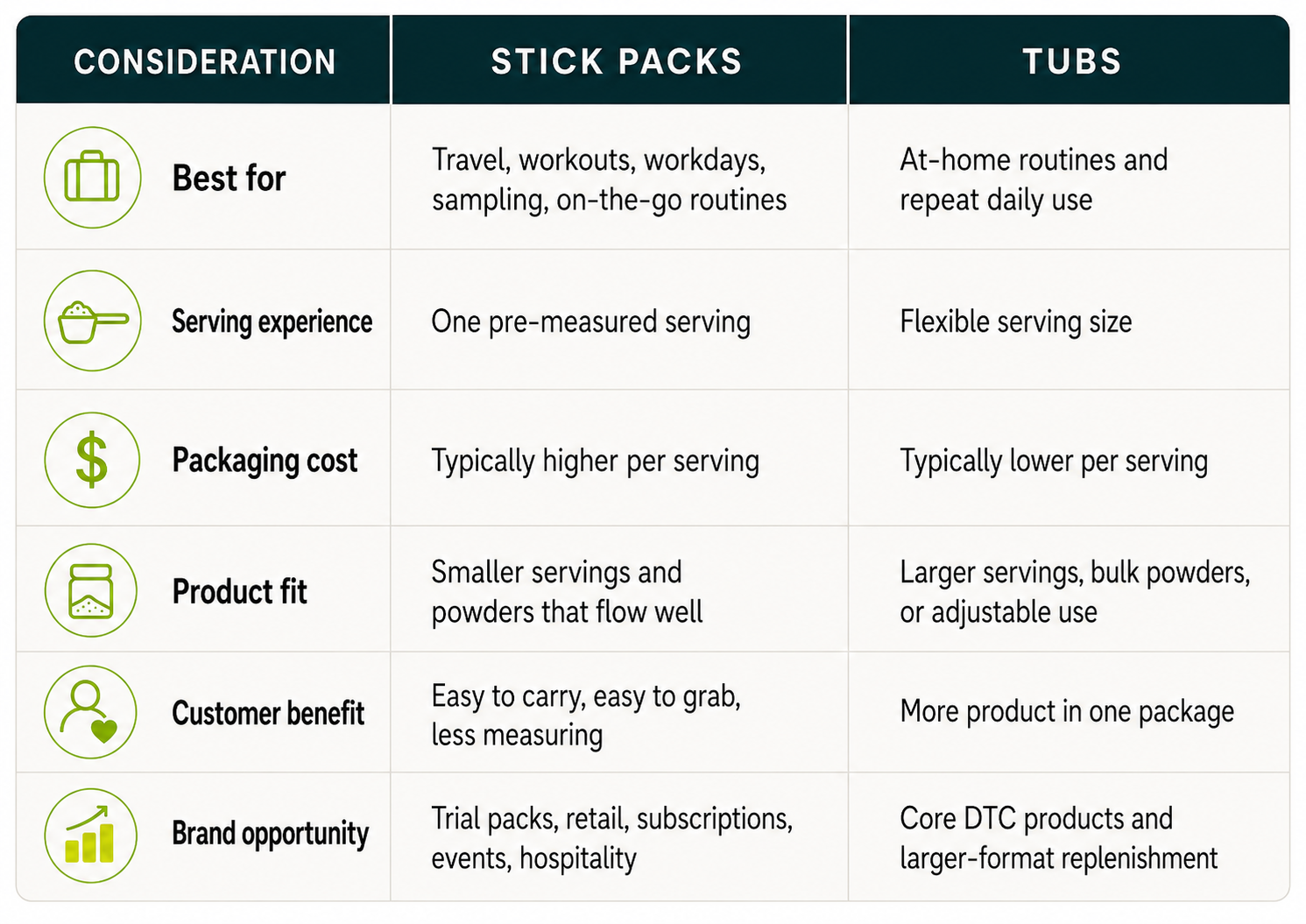
Neither format wins every time. The right choice depends on the formula, the customer, and the business model behind the product.
A tub can be the right answer for a protein powder, a larger daily blend, or a product where customers expect to control their serving size. A stick pack can be the right answer when precision, portability, trial, or convenience are part of the product value. The mistake is treating one as more modern than the other without assessing potential experience friction.
Don’t Force a Product Into a Stick Pack
There is a difference between using a stick pack because it improves the product and using one because it looks more premium, convenient, or current. One creates a stronger experience and the other creates unnecessary problems.
A large-serving powder may need multiple stick packs to deliver one use. A formula with a difficult texture or flow profile may not perform well in the format. A product designed for daily use at home may make more sense in a tub where the customer can adjust their serving size.
There are also basic manufacturing questions that need to be answered early.
Can the formula fit in the format without making the serving awkward?
Does the powder flow well?
Will the package protect the product from moisture, oxygen, or other environmental factors that could affect quality?
Does the product still taste and mix the way it should?
Does the cost structure make sense for the customer, the channel, and the business?
These questions are not there to make the process harder. They are there to prevent brands from building something that looks good on paper but is an issue after launch.
Customers do not care about the production decisions behind the product.They care whether you thought about them or not.
The Format Should Support the Business Model Too
A stick pack is not only a packaging decision. It can change how the product enters the market.
A brand may use single-serve packs to lower the barrier to trial. Instead of asking someone to commit to a full tub, they can offer a smaller entry point through a sampler, starter kit, bundle, or event giveaway.
A stick pack can also help brands expand into places where a tub does not make sense.
Hotel and hospitality partnerships, boutique fitness studios, retail checkout displays, travel kits, corporate wellness programs, subscription add-ons, influencer mailers, or variety packs designed around flavor discovery.
Of course that doesn’t mean brands should build an entire product strategy around samples, but it helps them consider how different formats can be experienced before consumers make a larger commitment.
Ask Better Questions Before Choosing a Format
Before a brand decides on stick packs, it should be able to answer a few things clearly.
What moment is this product meant to support?
A format should match the real use case.
A product built for on-the-go may benefit from portability in a way a countertop ritual does not.
Does one fixed serving make the experience better?
For some products, one exact serving creates simplicity and consistency.
For others, the customer may need more flexibility.
Can the formula fit without compromising the experience?
A stick pack should not turn into a workaround.
The serving size, powder density, flavor, texture, and mixability all need to work together.
Does portability create more value than cost?
Single-serve packaging generally costs more than a tub on a per-serving basis. Expect to pay about $1 to $1.50 more per 30 pack and keep in mind there will be a slightly longer lead time.
The customer has to feel the difference in usefulness.
What does the format open up for the brand?
Sampling, retail, subscriptions, travel, partnerships, starter kits, and flavor variety can all change the opportunity.
The format should support the business plan, not sit outside of it.
Will the customer reach for it again?
This is the question that matters most.
Not whether the format looks current, but whether it makes the product easier to keep in rotation.
Build the Format Into the Product Earlier
The strongest products are not built through a series of handoffs, but better early decisions.
Formula affects serving size.
Serving size affects format.
Format affects portability.
Portability affects the routine.
The routine affects whether someone keeps using the product.
At Factory6, we look at the full picture early: what the product is meant to do, how it needs to taste, where it will be used, what format supports that experience, and what it will take to produce it well at scale. We know format isn’t a finishing touch. It is part of how the product works for your customers and your growth.
Stick Pack Supplement FAQs
Are stick packs more expensive than tubs?
Usually, yes. Stick packs typically carry a higher packaging cost per serving than tubs because each serving is individually packaged. That does not make them the wrong choice. It means the added convenience, portability, sampling opportunity, or channel strategy needs to justify the added cost.
What types of supplements work best in stick packs?
Stick packs can work well for hydration powders, energy products, collagen, beauty blends, greens, travel wellness products, immunity support, and other powder formulas with a serving size and flow profile that fit the format.
The product still has to be evaluated individually. A formula that works well in a tub is not automatically a good fit for a single-serve stick pack.
When does a tub make more sense than single-serve packaging?
A tub often makes more sense for larger serving sizes, bulk powders, products customers use primarily at home, or formulas where serving flexibility matters. It can also be a more efficient option for brands focused on lower packaging cost per serving.
What should brands consider before choosing stick pack manufacturing?
Brands should consider the formula’s serving size, powder density, flowability, flavor, mixability, packaging requirements, cost structure, order volume, intended sales channels, and how the customer will use the product.
The format should support the product experience and the business model behind it.