SOME PRODUCTS ARE MEANT TO SELL OUT
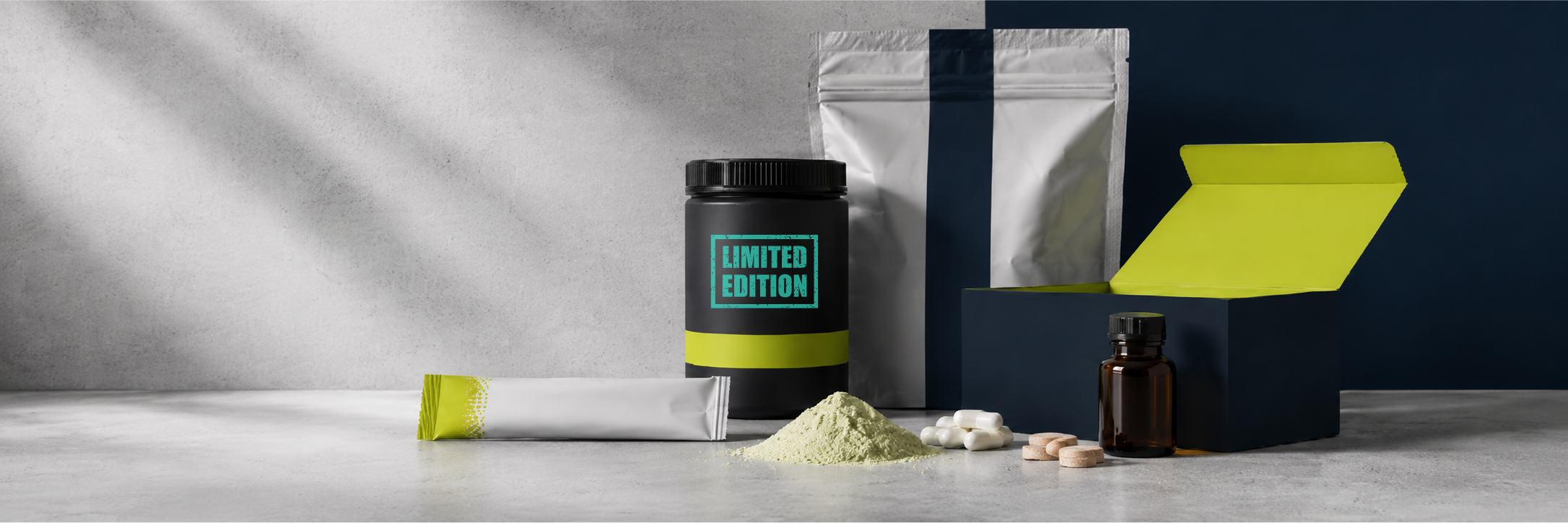
Supplement brands have traditionally treated every new SKU like a permanent addition to the family. Once it launches, it gets shelf space, packaging, forecasts, inventory, marketing support, and a place in the product lineup that people have to continuously justify.
That approach makes sense for the products built to become a brand’s core business, but it doesn’t have to apply to every good idea.
Limited-edition flavors, collaborations, seasonal releases, and product “drops” are becoming a bigger part of consumer brands in general, and supplements are starting to have more fun with the model too. Protein powders are showing up in temporary nostalgic flavors. Functional beverage brands are releasing online-only products. Existing formulas are getting short-term flavor extensions that may disappear once the inventory is gone.
Some come back. Some become permanent. Some sell through and do exactly what they were supposed to do. Not every product has to live forever to be worth developing.
LIMITED CAN BE A STRATEGY
A limited run gives an established brand something a permanent SKU usually cannot: permission to experiment without immediately committing to another forever-product in the portfolio.
Maybe consumers keep asking for a flavor that feels a little too risky for the core lineup. A collaboration creates an opportunity that only makes sense for a certain period of time. A current food or beverage trend translates unusually well to one of your existing products. Maybe your team simply has an idea good enough to try without pretending you already know it deserves five years of shelf space.
There is major consumer appetite for that kind of novelty.
The Vitamin Shoppe’s 2026 Health & Wellness Trend Report found that more than half of consumers say flavor meaningfully influences their supplement purchases. The retailer also reported double-digit growth among sports nutrition brands known for memorable flavor experiences.
That doesn’t mean brands need to manufacture bizarre flavors just to get attention, but it does suggest that product experience has become a legitimate part of differentiation, particularly in categories where the functional story itself is getting crowded.
A limited release gives brands a way to explore that differentiation without rebuilding the entire business around it.
KNOW WHAT YOU’RE TESTING
This is where a fun idea can either become useful product development or just create a lot of extra work. If you are using a limited release to learn something, decide what you want to learn.
Maybe you want to know whether an existing customer will buy the same formula in a more adventurous flavor. That is a fairly controlled experiment. Maybe you want to see whether one of your core products can reach a different consumer through a collaboration. Maybe the question is whether a familiar formula becomes more appealing in another delivery format.
Those are useful questions.
Changing the formula, flavor, format, package, positioning, audience, and distribution channel all at once makes the answer much harder to interpret.
If the product takes off, what worked?
If it doesn’t, what didn’t?
There is nothing wrong with building something completely new, but that is a new product launch. Calling it a “drop” does not make the development any simpler. The smartest limited concepts tend to know which part of the product is supposed to be new and which parts are already proven.
TEMPORARY DOESN’T MEAN TINY
This distinction is especially important on the manufacturing side. A limited-edition product can be temporary without being a tiny production run.
Manufacturing equipment still has minimums, ingredients still need to be sourced, packaging has order quantities, labels need to be printed, production still has to be scheduled. Finished goods obviously need to be tested, released, shipped, and stored somewhere until consumers buy them. None of that disappears because you added “limited edition” to the launch plan.
The real question is whether the expected demand makes sense against the production requirements of the product you want to build.
For an established brand with enough velocity, a production run that would be substantial for a smaller company may still work perfectly as a limited release. The inventory is finite by design, the brand has a plan to sell through it, and nobody is assuming the product needs to stay in production indefinitely.
That is very different from wanting 500 units of an experimental idea from equipment built to manufacture at commercial scale.
YOUR EASIEST DROP MAY ALREADY EXIST
Not every limited product needs a new formula. In fact, one of the most efficient places to experiment may be a product platform that already works.
A proven powder formula can take on a completely different personality with a new flavor direction. A familiar active system might make sense in another format. A successful SKU could become the base for a collaboration without asking R&D to reinvent every part of it.
Keeping more of the product stable can also make it easier to understand the results.
If consumers already know the formula and suddenly a new flavor sells out, that tells you something. If the same function performs differently in a new format, that tells you something too. This is all fantastic information for you to gain and learn from.
Brands sometimes associate innovation with changing everything, but product development does not have to work that way. A small, intentional change to a strong product can create a surprisingly different consumer experience.
LIMITED DOESN’T MEAN RUSHED
This may be the least exciting part of drop culture, but a limited release still needs a real timeline.
Seasonal concepts are particularly unforgiving. A summer product that arrives in September has missed the window. A collaboration tied to an event or campaign cannot simply move three months because one ingredient took longer to source than expected.
That means the calendar has to work backward from the launch.
Formula development, flavor work, ingredient sourcing, packaging, testing, production scheduling, and release all need room. Packaging with custom artwork or collaboration-specific components can create another timeline entirely.
The more ambitious the concept, the earlier the manufacturing conversation should start.
There are certainly ways to make a limited release easier to execute. Existing ingredient systems, familiar packaging, proven formats, and realistic flavor changes can all reduce unnecessary complexity. Trying to create an entirely new formula, source unusual raw materials, develop custom packaging, and get it onto shelves in six weeks because the trend is hot right now is a different situation. At that point, the trend may be gone before the product leaves production.
PLAN FOR SUCCESS TOO
Most brands understandably spend more time thinking about what happens if a new product does not sell. Limited releases have the opposite problem sometimes.
What happens if everyone loves it?
“While supplies last” sounds great until the supply lasts approximately four days and the comment section starts asking when it is coming back. Not a bad problem to have, but it is something worth discussing before launch.
Can the raw materials be sourced again? Was any component custom or difficult to obtain? Can the packaging be reordered? Does the flavor system have reasonable lead times? Is there a path to another run if demand justifies one? Most importantly, is the brand willing to bring it back?
A limited product does not have to remain limited simply because that was the original plan. Some concepts earn another run, others return seasonally, and a few prove that consumers wanted the idea badly enough for it to join the permanent lineup.
That is part of what makes the strategy interesting. A temporary SKU can generate demand while also giving the brand actual market feedback about what deserves to happen next.
A SELL-OUT ISN’T THE ONLY WIN
Limited launches also do not need to become permanent products to have value.
They can give existing customers a reason to come back to the brand and create new creative material for sales and social teams. Collaborations can put a product in front of an audience the brand does not normally reach, and a bold flavor can tell you how far consumers are willing to go with you.
Sometimes the answer is simply, “That was fun. We sold it. We learned something. Next.” and that’s perfectly fine.
The supplement industry can be serious about formulation, efficacy, quality, and scale without requiring every product decision to become a massive commitment. In fact, having a strong core lineup is typically what gives an established brand room to take calculated swings.
BUILD THE DROP LIKE A REAL PRODUCT
There is a reason limited releases are getting more buzz. They create urgency and give consumers something new to talk about. They allow brands to respond to culture a little faster and take creative risks that may not belong in the permanent assortment.
None of that changes what has to happen behind the scenes.
The product still has to taste good, the formula has to work and the format has to manufacture well. The quantities and timeline still have to make business sense.
A drop is not a shortcut around product development. It’s simply a different way to think about what happens after the product is developed.
Your next SKU might become a bestseller you manufacture for the next decade, it might come back every summer, or it might sell out once and never be seen again. All three can be successful outcomes if you knew what you were building from the beginning and why.
HAVE AN IDEA WORTH TESTING?
If your brand is considering a limited release, collaboration, seasonal flavor, or another product idea that doesn’t necessarily need to live forever, bring your manufacturing team into the conversation early.
Factory6 works with established supplement brands on formulation, flavor, and commercial production, including the products that are a little more interesting than business as usual -that’s our sweet spot!